
Maang Tikka vs Matha Patti vs Jhoomar: Forehead Jewellery
Three pieces, one forehead, endless mix-ups. A maang tikka is the single pendant that hooks into your hair at the parting and drops to sit on the forehead. A matha patti takes that same idea and widens it, adding chains that fan across the hairline to frame the whole brow. A jhoomar, also called a passa, skips the centre completely and pins to one side of the head like a small jewelled fan. Same stretch of skin, three different stories.
The names get swapped around all the time, usually by people who have owned only one of the three and assume it covers the rest. It does not. Knowing the difference changes what you buy, how you wear your hair, and how the whole look lands in a photograph.
The maang tikka: the one almost everyone starts with
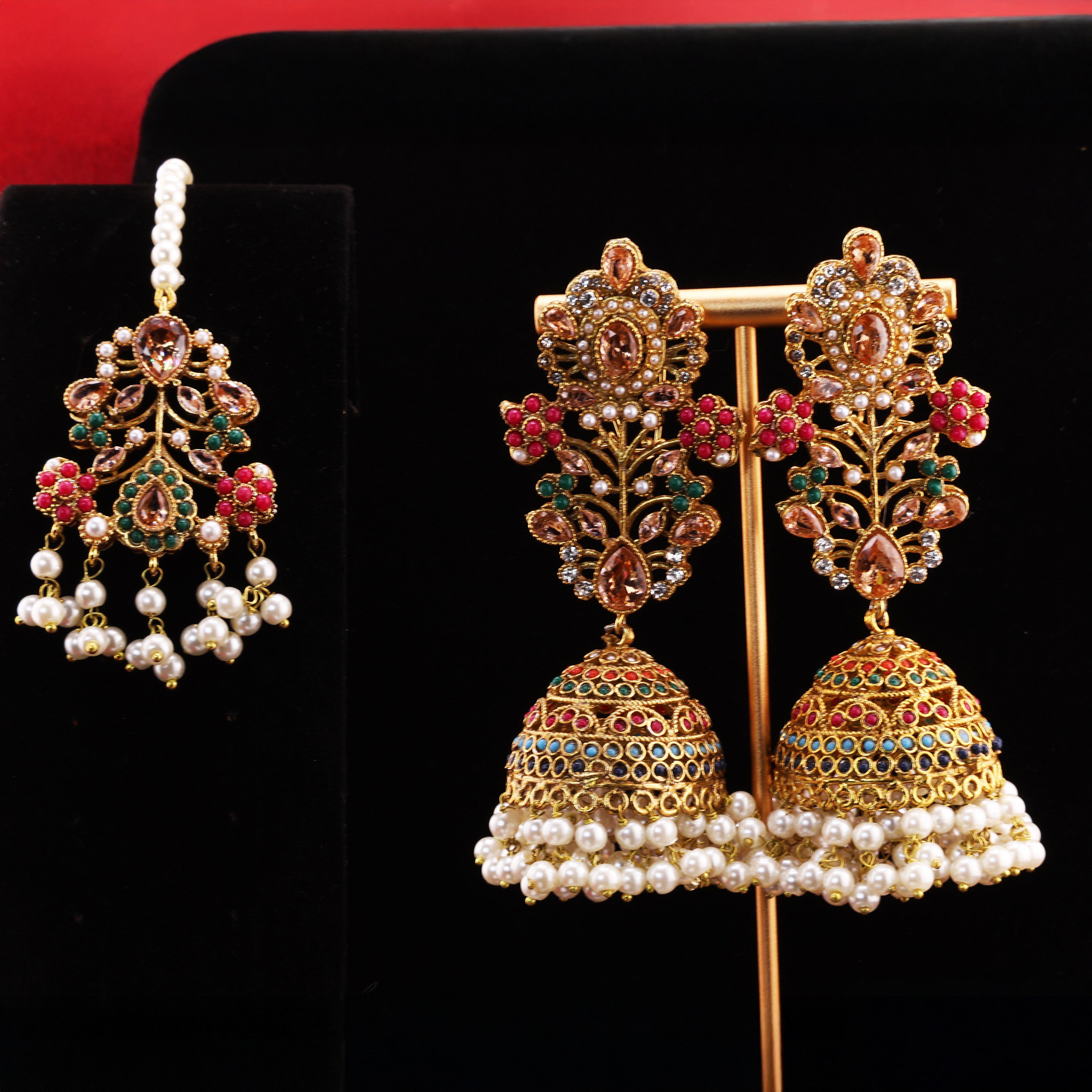
The maang tikka is the workhorse of forehead jewellery. A central pendant hangs from a short chain, the chain hooks into the hair at the parting, and the pendant rests just above or between the brows. That is the whole design, and its simplicity is the point. A tikka can be small and barely there for a daytime nikah, or large and layered for a reception, and it pairs with almost any neckline because it draws the eye up to the face rather than competing with a necklace.
This is also the most forgiving piece for anyone wearing forehead jewellery for the first time. It needs only a centre parting and a single secure pin, it suits a guest as easily as a bride, and it works with an open style or a bun. If you are buying one piece for the forehead and want it to work across several events, the tikka is it.

The matha patti: forehead jewellery that frames the whole brow
A matha patti is a maang tikka that did not know when to stop, in the best possible way. It keeps the central pendant and adds side chains that sweep out from the parting toward the temples and ears, so instead of one point of interest you get a band of detail running across the forehead. The effect is grand and unmistakably bridal, which is why the matha patti belongs to the main event rather than the smaller functions.
It asks a little more of you. The side chains need a hairstyle that shows them, so a sleek centre parting with the hair pulled back reads cleanest, and a fuller forehead gives the chains room to sit properly. Worn with a heavy lehenga and a covered neckline, a matha patti carries the regal, Mughal-court feeling that North Indian and Pakistani brides have leaned into for generations. If your outfit is already loud at the neck, though, a matha patti can tip into too much. Pick one focal area, not two.

The jhoomar, or passa: the side-swept showpiece
The jhoomar breaks the symmetry on purpose. Shaped like a small fan or crescent and usually strung with tiny pearls along its edge, it pins to one side of the head, traditionally the left, just above the ear or at the temple. Its roots are Mughal and Hyderabadi, and it has long been a signature of Muslim bridal looks in particular. Where the tikka and matha patti centre the face, the jhoomar throws the interest off to the side, and that asymmetry is exactly what makes it feel special.
You can wear a jhoomar entirely on its own for a striking, slightly unexpected look, which makes it a favourite for the mehndi or sangeet when a bride wants something that photographs differently from the main bridal set. It also layers beautifully with a maang tikka: the tikka holds the centre, the jhoomar weights one side, and together they fill the head without crowding it. Pearls and antique-gold finishes suit the jhoomar especially well, since the soft sheen matches its old-world character.
How to choose between them
Start with the occasion and the hairstyle, because those two decide more than the price does. For a nikah, a mehndi, or any time you are a guest, a maang tikka is almost always the right scale. For your own wedding day, when the outfit is at its heaviest and the photographs matter most, a matha patti or a jhoomar gives the forehead the drama the day calls for. Save the boldest piece for the moment you most want to remember.
Face shape helps too. A maang tikka draws a vertical line down the centre, which lengthens a rounder face and keeps everything balanced. A matha patti spreads horizontally, so it flatters a longer or narrower face by adding width across the brow. A jhoomar suits almost everyone precisely because it sits off-centre and does not have to balance anything, it just adds a flourish. Match the piece to your hairline as well: high foreheads carry a matha patti easily, while a jhoomar needs enough hair on the side to anchor the pin.
Wearing more than one
Brides increasingly combine these pieces rather than choosing just one, and the looks that work all follow the same rule: let one piece lead. A maang tikka with a jhoomar on the opposite side is the classic pairing, balanced but not matchy. A matha patti is usually enough on its own, since it already covers the forehead, but some brides still add a small jhoomar for height on one side. What rarely works is a large matha patti and a large jhoomar fighting for the same space. When everything shouts, nothing stands out.
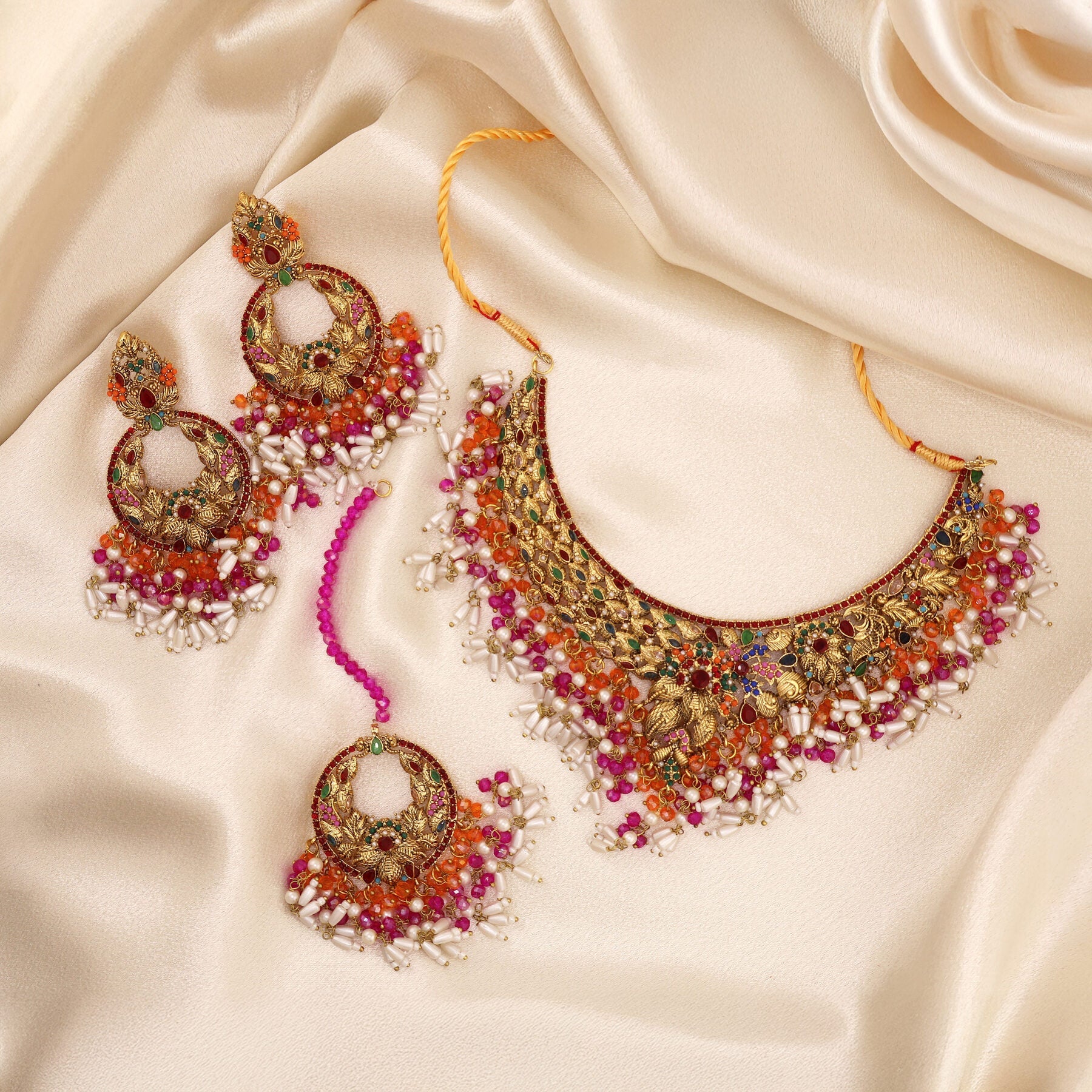
Whichever piece you land on, treat it as part of a coordinated look rather than an afterthought. The forehead is the first thing a camera finds, so the tikka, matha patti or jhoomar should share the stones and gold tone of your earrings and necklace. You can see how the pieces sit together in our maang tikka and earrings collection, and the Jahanara set is a good example of a tikka designed to match the rest of the suite. For the fuller, forehead-framing looks built for the big day, start with the bridal jewellery collection and let the occasion tell you how far to go.